
Casio-CT-X300 - AiX Digital Synth Review
Hello! We didn't see for a long time, and I have a bunch of a reasons for this - starting from my busy dchedule, and my motivation to work more on The Great Band records. Honsetly, I have plans to redesign my website more as The Great-oriented webpage - put some more information on releases and character stories, make a separate "articles" block for my Danielsblog publications. Anyway, I have some interesting for you - Casio CT-X3000.
Introduction
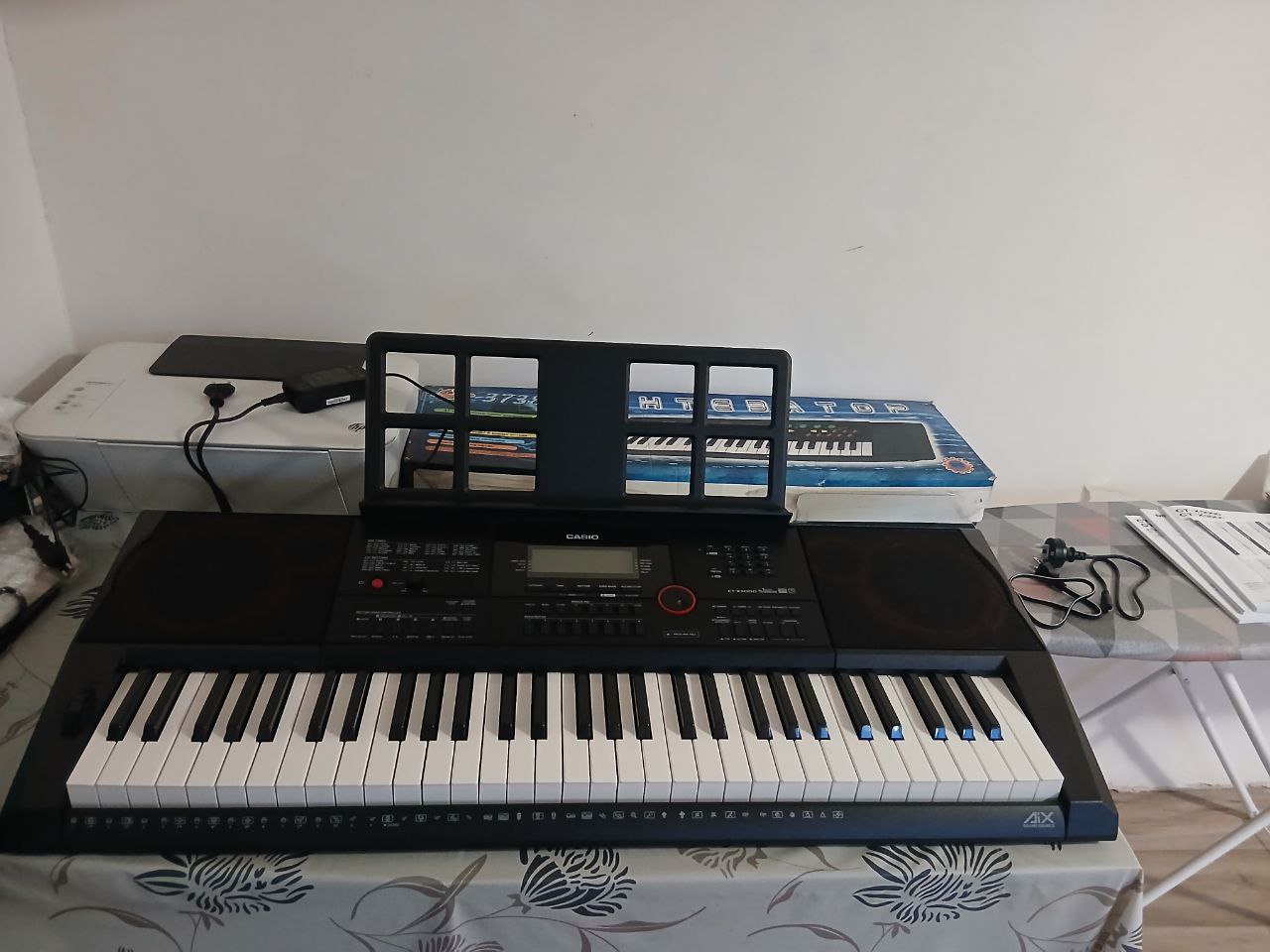
My beautiful synth! :P
I didn't even have a microphone to record my guitar, so I used to record my ideas on smartphone, and have no headphones to head all the diffirance between bad and good sound quality.
Back in the early days of this website (2022), I only started my journey in music-making world. I have no clue how bands like Linkin Park make their music - all I have is an acoustic guitar and simple DAW called LMMS.
Before, I never deal with expansive instruments like this one. Back in 2022, my brother gave me his old toy synthesizer, which could play only two notes at the same time, and feels more like a toy piano than a low-budget synth. But, this help me a little bit to improve my musical ear, and I learned some simple melodies from my favorite Nine Inch Nails and Linkin Park. The same time, I played acoustic guitar and make music on computer with LMMS.
Everything changed when I bought my first audiocard in January 2025 - Focusrite Scarlett Solo, with mircophone and headphones included in bundle.
I belive, this is the best thing I ever could do for my music career - I started to learn mixing, music production and sound design. I decided to stop playing guitar, since I found myself in EDM music. I take this decision to concentrante more on my audio quality, and come back to guitar, when I become good at mixing, knowing all the basics.
Knowing how to make a great mix isn't enough if you don't have a song. Composing is kinda diffirent side of music - instead of playing with sound textures and noises, you choice instrument and play with it. Composing it's like downloading some orchestral library and painting your own soundscape.
But, composing music with computer only require buying a lot of sound libraries, which requires a large hard drive and powerful CPU. This is not the way I like to make music - have a bunch of diffirent samplers and smaple libraries just to feel comfortable. Also, I've notice some of my favorite sample packs like Vengeance have a really bad recorded live instruments, and VST plugins like Modo Bass by Fender didn't give me a Slap Bass sound I want.
So, I decided to focus on composing - I need an instruement, piano - and I found this Casio pretty good, even if it's expansive (600€), but I don't care about money, if it's something I need.
Review
Casio CT-X3000 is a digital sample-based synthesizer. Having over 800 preintalled instruments, and 100 slots for your own user-defined "tones" is literally like a "laboratory" for composer.
A powerful AiX engine gives you so many useful functions, which gives you almost infinite possalibities inside your synth only, but you could also record synth's output with Jack 6.5 to Jack 6.5 cable with you Sound Card and process sound with your DAW's plugins and functions, giving you a really unexpected results.
I don't know so much about pianos, synths and other keyboard instruments, I used to play melodica, and switching to standard-sized keys is unusual, but pretty comfortable feeling.
Making music on separate device give me my favorite "limitations" - instead of haveing all these Kontakt Libraries, and torturing my slow CPU, I can concentrate on composing itself.
Working with it, I've learned how to record with my Scarlett audiocard, synchronize it between DAW and my equipment, and didn't care about sounds tweaking.
Recording synth with Focusrite Scarlett Audiocard
Since I never have an experiance with recording my own instruments, there is some important thing about your audiocard settings.
To get an audiofile of your next masterpiace, you need to have two things - an audio interface like Focusrite, and Jack 6.3 cable - my audio interface could record only mono signal, so I have a simple mono cable.
There is two ways of recording your song - the first one is trought USB-MIDI interface - you simply use keyboard as controller to record MIDI data in your DAW, and then send it back to a synth - I like this one, because I'm not a professional piano player, so I can fix any of my huge and little mistakes.
The second one, is record straight trought audiocard. If you use Focusrite audiocard, make sure to enable "Instrument" mode, which works like a preamp for your input signal. Set gain knob to 30-40%, and 80-90% on you synth - you shouldn't hear any analogue noise, and have a good audio quality in a peak gain around -6 or -3db.
Playing presets in your DAW
By default, if you connect your synth to computer via USB type B cable, you can play General MIDI presets - nothing special, since every MIDI synth could do this. But what about AiX instruments? Since you have over 800 preinstalled instruments, I belive this is what you want to play. Trying to understand this simple idea, I wasted a lot time and attempts, switching my DAWs and doing other things.
In Reaper, create an empty MIDI file on a new channel. Better, if you label your tracks with Casio synth's preset number, and it's name to have less problems in future. Route it's MIDI Hardware Output to "Casio USB-MIDI". Try to play some notes, you should hear a default MIDI piano going out of your speakers. Great!
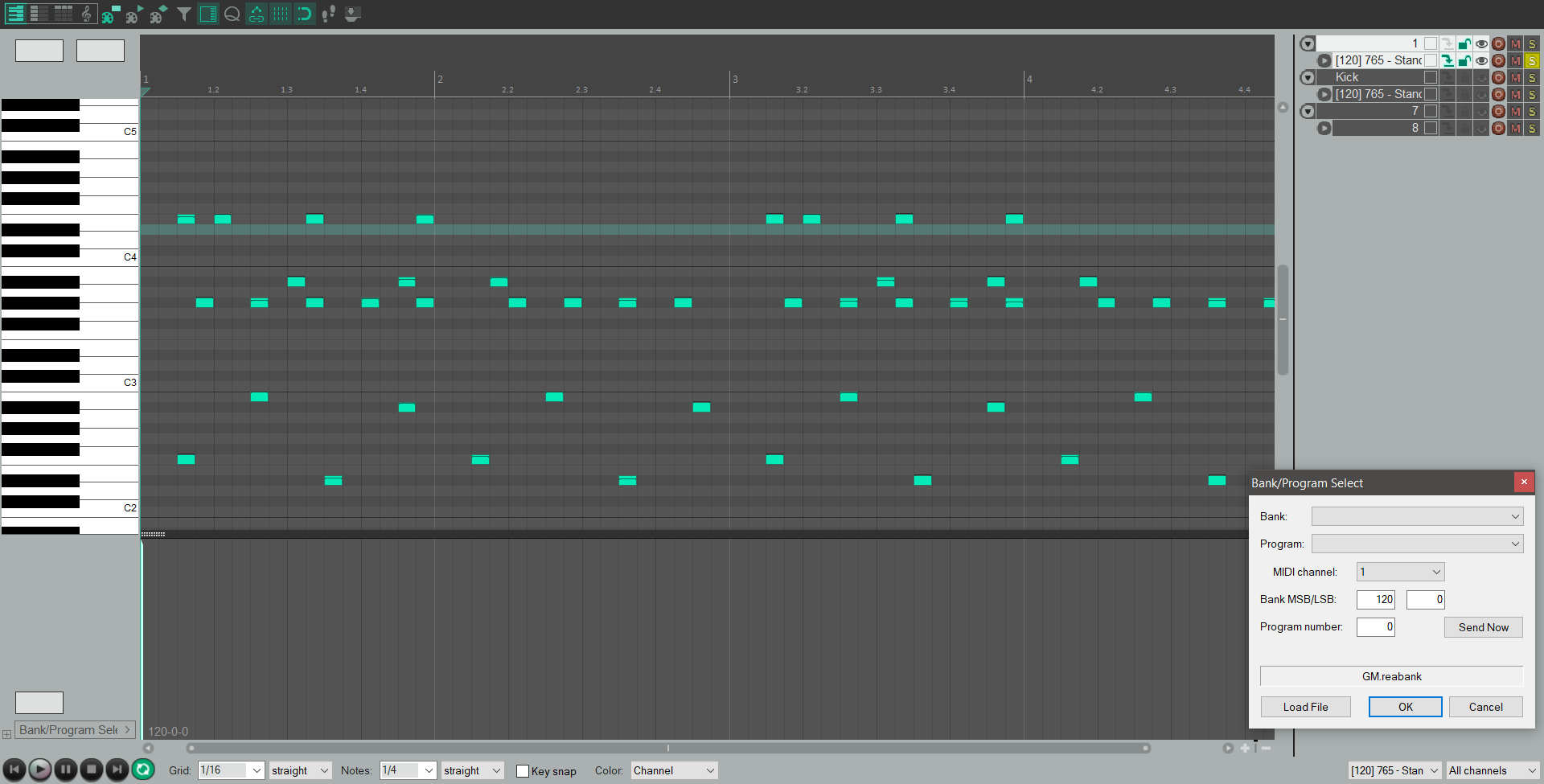
To change instrument, change MIDI automation parameter "Velocity" to "Bank/Program Select" in MIDI clip editor, and create new event at the beginning of midi track by double-clicking. Now you have a "Bank/Program Selection" window - you could load preinstalled file to choice between General MIDI instruments and banks, or randomly put some numbers between 0 and 127, and just have fun finding some strange sounds.
To play AiX sounds, use this csv table, and put it's MSB/LSB and Program parameters on this window - if you are going to use a few instruments the same time, select a diffirent MIDI channels for them. I found this table on Casio music forum, but right now I cannot find it's original author - if you found one - let me know.
Isn't VST's enough?
Music genres like Rock music is all about live performance - it's important to have a real drum kit, guitar with all the fret noises and mistakes people usually do - there's no universal way to record virtual guitar the same good as the real one.
But, talking on EDM production, there's where things gets interesting. In 2000s, computers become a really serious instrument for music production, not just and instrument to record Nirvana's "Nevermind". VST instruemtns gets better, and right now we have a really good sound design and composing engine.
Producers like Skrillex, back in 2009-2010 made their "Scary Monsters and Nice Sprites" using his MacBook only, with all the mixing, mastering and sound design. It proves you don't really need an expansive hardware to make great records.
On the other side, Deadmau5 uses analogue and modular synths in his records, which gives him a wide range of sounds, from retro 80s Synthwave and Retrowave, up to 2010's Electro House/Dubstep stuff... Today, Skrillex and Deadmau5 use software and hardware together, their studio is full of different equipment and software plugins. But, why do I need hardware digital synth if I'm doing Electro House? This is genre which highly depends on virtual instruments and software processing.
First of all, let's discover, how does Casio CT-X300 works! Actually, if you have experience with samplers like NI Kontakt, you are know how this synth works - basically, this synth have a really big sound library (around 800 sound kits), with wide velocity range and effects.
I'm not really comfortable with using sample libraries and virtual instruments in my songs - I know Native Instruments Massive very good, so I could synthesize sounds myself, but it's not enough, since sometimes I need a real slap bass guitar for funky fills - I tried a bunch of diffirent virutal bass guitars, but instruemtns like Fender's Modo Bass have so many limitations in a free version - dealing with Casio CT-X3000, I have a few diffirent Slap Bass presets, they are really clear in sound, so I could pick the tone I need and just record it, without any stress for my weak CPU. Anyway, nothing could replace a real acoustic instruments!
Other Great Features
Casio CT-X3000 have two 6V speakers - and you can play your own music, by connecting jack-jack cables to your smartphone or notebook. I listened all the Undertale soundtrack and some EDM/Rock music with it, and I think this is a really good alternative to headphones for mixing my music.
Also, I have fun watching Avatar: the Last Airbender on it's speakers: bsky.social :D
There's also 150 Arpeggiator presets, with MIDI out function, so you could write a fast EDM fills just by playing one chord, without any VST plugins!
Sometimes, I also use Drum Rythms, and there's over 290 presets, with 4 diffirent variations on each preset in a diffirent time signatures - from 3/4 and 4/4 to 6/8. It helps me sometimes to get in a mood of Christmas music, Bossa Nova or even Blues Rock. You could find a lot of famous Drum Beats like Michael Jackson's "Billie Jean" or Ed Sheeran's "Shape of My Heart" here.
Functions like Split/Sustain/Portamento/Layer helps you to create an unusual tones from a basic instrument blocks. As example, you could combine Piano and Strings, or play bass notes with acoustic bass guitar, while you have an acoustic guitar as lead. If you have no computer nearby, you could easily record your idea with it's native 16-bars sequencer, so you could record 10 diffirent little ideas, quantize and edit/rewrite them on the go!
Combining all this features, you could use it as some kind of classical analogue synthesizers - just took a preinstalled MIDI Square wave, then Saw Wave, combine them, adjust their volume and use some DSP effects like chorus, reverb, delay - use preinstalled ASDR to control it's volume changes during time, and save this as separate tone in a free slot.
To perform live, I belive you need to have some "loops" library - you could use your sequencer record as loops, to create music on the go! You have 4 pharse pads on a keyboard, and you could change and save presets in a diffirent slots, there's a lot in keyboard's memory!
There's some more on this synth, since it's manual around 200 pages long, but I'm not so good at music making to use all of them.
How to start making music
Talking on a background music composing process, it's pretty easy - but the same time, pretty tricky.
To get the result on level of the great visual novel OST's, like Kana: Little Sister, Katawa Shoujo, Saya No Uta, Undertale - you should master every part of music making process, you shoud have a good time-managment system, and consistent working process.
Toby Fox once written in a guide called “How Do I Get Good At Music?” this
Before I composed music, I learned how to play songs I liked by ear on the piano. It took me years to become proficient at it
There's no trick to make something good on your first try. Just try your best, and keep making things.
And I belive this is the only words you need to know to make music. I spent hours upon hours on watching music-making tutorials, but working on your own material is the most important thing you need - practice.
Maybe, you could learn something from watching tutorials on YouTube, but you should know how to use this tricks with your music-making process. If you have no good melody, chords and arragement already written, mixing tutorials is absolutly useless.
When I started to play guitar, I started from something small - just learned a few open chords, and I know nothing about musical theory - I just started to trying a diffirent chord progressions, playing them over songs I know, to uderstand which chord is good and which isn't. Then, I learned a basic music theory - chords, intervals, scales - so I started writing my own melodies. And everything ended up with me playing music by ear, just putting audio-file in Audacity, slowing it down, and trying to find the right notes, playing them separetly one-by one.
This been a good adventure before I started to make my own music - and I have to practice more, instead of learning how to do something right. You don't need to know all the music theory, but just to know where to get notes of any scale without table and breaking down melodies on separate notes and intervals is absolutley essential.
So this is the idea - before you even get started with your music making process - get familliar with your DAW, learn a few shortcuts, undertand how to write MIDI notes and record audio, but don't get too deep - you want to make songs, not sound design and mixing.
Your first song
Since you only started to produce music, I belive "in the box" and "limitations" philosophy is the best practices you could use - just install some little orchestral library, as example, free "Spitfire Audio BBC Symphony Orchestra", and just sketch some ideas - start with a simple 4-8 loop, and limit yourself to 4 midi tracks. DAWs like Reaper have a function to display only the notes of specific scale, so you shouldn't always check your notes in a scale.
Quick Tip: It's important to make your loop cycle through, which means your last chord should sounds good with your first chord in a loop.
As some base for your rythm, you could use a drum loop from a sample pack, or rain, campfire sounds for some more ambient-like peaceful songs.
It's important to not download too much samplepacks, I stopped on having this in my library:
- Deadamu5 Xfer Sample Pack
- Glitch With Friends[1-3]
- Vengeance [Dubstep 1, EDM 1, Effects 1, House 1+4, Rhythm Guitars 1+2] - Since all Vengeance packs is exactly the same, I downloaded this.
- Black Octopus Sound - Leviathan 3
It's better to have a small library of sounds you know pretty well, than searching a kick drum for hours, instead of making music. In a free time, create a folder "Favorite" and copy your favorite and commonly used samples. Also, you could record rain sounds by yourself, and have your own signature samples no one could recreate! :DDD
And, basically that's all - when you created your awesome chord progression, export it as a MIDI file, and put in a dedicated folder for your chords - it's better if you name your files something like this: [Cmaj] [128bpm] Peaceful Piano Chords
Also, you could use your DAWs proprietary file formats to save the full track with audio effects and automations - in Reaper this one is called "Templates".
To make a full-length track out of your simple 8-bar chord progression, you need to have an arragement - took some of your favorite tracks, which fits the best for your song idea - if this is something like EDM, I belive Zedd - "Follow You Down"" is absolutley the best, Three Days Grace's "Never Too Late" (Instrumental) is good for Rock music, Bible Black's "Grimoire" is good for some peaceful arragements with drums, and "Lamune's 79" from Narcissu for a slow background music.
There is two ways of song struecture analysis, the first - is by simply dividing song's parts using your DAW tools, like "Regions" in Reaper. It looks something like this:
- Intro - 16 bars
- Verse - 24 bars [Drums and More Elements Introduction]
- Build-Up - 15 bars
- Silence/Drum Fill Before Drop - 1 bar
- Drop A - 16-24 bars
- Verse
- Build-Up - 15 bars
- Silence/Drum Fill Before Drop - 1 bar
- Drop B - 16-24 bars
- Outro - 16 bars, usualy copies Intro in reverse
This is a song strucure of Zedd's "Follow You Down".
Also, there is another method, and they works good together - you simply import your favorite song, make an empty MIDI tracks in your DAW, and put empty MIDI records in your timeline, every track discribes specific instruments - like acoustic guitar changing by electric guitar in chorus, or there isn't drums except hihats at the end of the track.
Homework: Before starting your first big composition, just play around with some chords and melodies, then export them to MIDI files and give this ideas some time, you didn't know when you could fine a genious chord progression in your old ideas bin. Before trying to do something big, define your arragement structure - import audiofile and start analysing familliar composition, even if it's pen and paper, or view in your DAW arranger - diffirent methods give you absolute diffirent view on the same song. Spend some time giving your template a nice look with colors, icons and track grouping.
Try to analyse "Never Too Late" and "Follow You Down" by yourself!
When I started to compose music with my Casio keyboard as midi-controller, it's been a life-changing experiance for my music-making process. Before, I only draw midi notes in my editor, which is good for genres like EDM, but feels absolutley unnatural in the world of acoustic music. So, I belive even a cheap Akai controller, or a small synthesizer like Yamaha PSS-A50 is better than nothing.
Afterwords
We didn't see for such a long time, and I feel like this website move far away from it's starting point. When I just started, back in 2021, I've been inspired by Dig Deeper, Luke's Cabin, Luke Smith and many other great people from DigDeeper's XMPP chat - I still have friendship with some of them up to this day. But with time I stepped away from writing articles on privacy and technology (now it sounds kinda funny, because I'm writing articles in the biggest storage of user's personal data - Internet), and now my website feels like an organised chaos, because I could review erotic visual novel, and then release two articles about music, then dissapear for a few months, and start everything again.
This website become documentation of my toughts on loneliness, and record of my struggles with Tourette's Syndrome - when I started this blog, I couldn't even imagine something like this could happend. And now I feel myself like a crybaby, since people around me is dying every day, and all I do is just writing about my personal problems for a big community of people.
Visual novels become my new hobbie, since titles like Katawa Shoujo and Radiata literally changed my life for better, and then I started to learn philosophy little by little, inspired by Arthur Schopenhauer's ideas. In some kind, I feel like I already have everything I need - Family, time for music, and this blog, and by the same time lost a few imporant things forever.
I belive every of us have a period in life when we belive we discovered everything we need in this life - and I think the same right now. I already have a sketch of article, which discribe the most important piaces of art in my life. There's so many great things on the Internet, but not all of them we could understand, having a such small experience in our life, but since this is my website - I'm going to archive every good memory of my life. At the end, it inspires me to compose my music or write my own stories and articles, which represents my own "The Great" style.
Last time electricity in our regions in inconsistent, so I could sit for 2 days without electricity, and I noticed how monitors made our eyes move less, and because I have no electricity, I always move my eyes, hands and legs, but being concentrated on this little box you cannot look somewhere else.
Right now electricity problems is the only time I couldwrite for this blog, and right now I'm writing this afterwords by the same reason on a piace of paper, and listening to Kevin Macleod on background :D
Anyway, I'm doing my best to have a good future. I know how I'm going to spend my next 4 years in university. I already know I'm not going to be a software developer, but more like a DevOps, since I started this blog, I written so many articles on Linux administration, and only a few on a real programming - I like to edit configs, set up servers and everything like this, and I never been good and motivated for a graphical design. However, I usually read books on Low-level tech and High-level programming. I used Linuix for a few years on my main computer and lwarned a lot on building software, patching and updating software.
I feel like I did something wrong. I started to learn Linux in a hard way - I installed Slackware on my main computer and use it for every day for last three years, but then I started to produce music - I have an unusual feeling of hyperfixation on my future career as a musician, but music is not something I would like to use as my job, since music is just the best thing in this world.
For the next four years I'm going to concentrate on learning and improving my knowledges about Linux, Bash, Python, Docker, Nginx, SQL and technologies like Ansible and Terraform - this is my base to a better job in future, so I could have money for a new musical instruments, and maybe even starting releasing my music worldwide on Spotify, and CD/Vinyl.
I'm making music for fun right now, so I cannot release tracks with a good mixing once a month, or even maybe once a 6 months, but I'm doing my best and trying diffirent ideas every day. As example, I made a Heavy-Metal track in 60 minuites using my Casio preintalled Gauitars and Drums.
Musical producers like She Music have a really good community, since Lain (Shemusic) could release an album and stay quiet for a few years, until release a single song in one year. Yes, this is awesome, since he knows his community likes him, and he's pretty sociable on his Discord server.
And I want to have the same community - I like my regular blog visitors, I like everyone here, even if you see my website for the first time. Last days I'm thinking so much on my future life - and I want to have a good job, and use music and this blog as my diary. I don't like the idea of releasing song in genres that popular right now because of money - I want to release my favorite Complextro and Electronic Rock, but music like this takes months to be released.
It's pretty romantic idea to live with your music only, but you cannot have a good future if you put all your efforth in music - I want to be able to buy new instruments and plugins, maybe a new computer or even house for my future life. And right now I'm going to write some more articles on DevOps - many of my readers really like my Linux/Programming articles, but I didn't know what I could write for this, and now I'm just going to document my studying process, making some little guides or tips and tricks like in a good old days. I didn't release something new for so long, and I'm so sorry - I don't want to blame someone or something, I just need to accept thar I need to get some more discipline and review my views on my future life. Right now I'm learning and improving my knowledges in Linux, so I have something to say in my future articles.
There's a lot to learn, and much more to do, but wish O could post some more here. 'm optimistic about my future career. Complextro music is kinda hard to compose and arrange, but I also make orchestral music. Maybe in future you see my songs in my friend's visual novel, but her novel is in early development state, so I know nothing about the real future of this project. If I found free time this summer, I would like to release 3-track EP, my friend already gave me an awesome album cover - you may know him by "Careless" artwork.
Thanks to everyone who read this, thanks to everyone who visit my website, and thanks to people who listen to my music! I'm going to write a new articles soon, about may experiance with setting up Ansible environment for a local network.
Written: 02.01.2026
Last Edit: 24.04.2026
